Roof Repairs
Repairs on Hills District roofs, where blocked valleys under established gums and corroded valley iron cause most leaks.
Learn more →Gutters, fascia, downpipes and non-combustible leaf guard built for established gums across Castle Hill, Glenhaven, Galston and Dural. Free inspection.
Across the older suburbs, water rarely gets into a house because the roof failed. It gets in because the water had nowhere to go.
Gum leaf and bark fill the gutter. The outlet blocks. The gutter fills to the lip and then backs up behind the fascia, over the top edge, into the eaves and down the inside of the wall. On the roof itself the same debris packs the valleys, which pushes water sideways under tile laps. Then the valley iron rusts through from the bottom where the wet debris sat all year.
None of that is dramatic. It is just slow, cumulative, and it accounts for a very large share of the ceiling stains in Castle Hill, West Pennant Hills, Cherrybrook, Glenhaven and Dural.

Most leaf guard complaints come from the wrong product rather than from the idea.
A token plastic mesh under established eucalypts will be brittle in a couple of summers and sagging into the gutter before that. The specification that works here:
Properties on the northern and western fringe — around Galston, Middle Dural, Kenthurst, Annangrove and Maraylya, against the Berowra Valley and Cattai bushland — are frequently mapped as bushfire prone. Gutters packed with dry eucalypt litter are a classic ember trap, and gutter mesh on those blocks must be non-combustible metal. Your section 10.7 planning certificate confirms whether your land is affected.
Gutter work in this district splits the same way roofing does.
On the large two-storey brick homes through Castle Hill, Baulkham Hills, Kellyville and Glenhaven, the gutter is the easy part and reaching it safely is the job. Sloping blocks, courtyards, pools and tight side setbacks all change the set-up.
On acreage at Dural, Kenthurst, Annangrove and Maraylya, the runs are long and often continue across sheds, stables and verandahs. Long runs need accurate fall, adequate expansion allowance and enough downpipes — and on tank-water properties, the whole system is also a drinking water catchment, which raises the standard rather than lowering it.
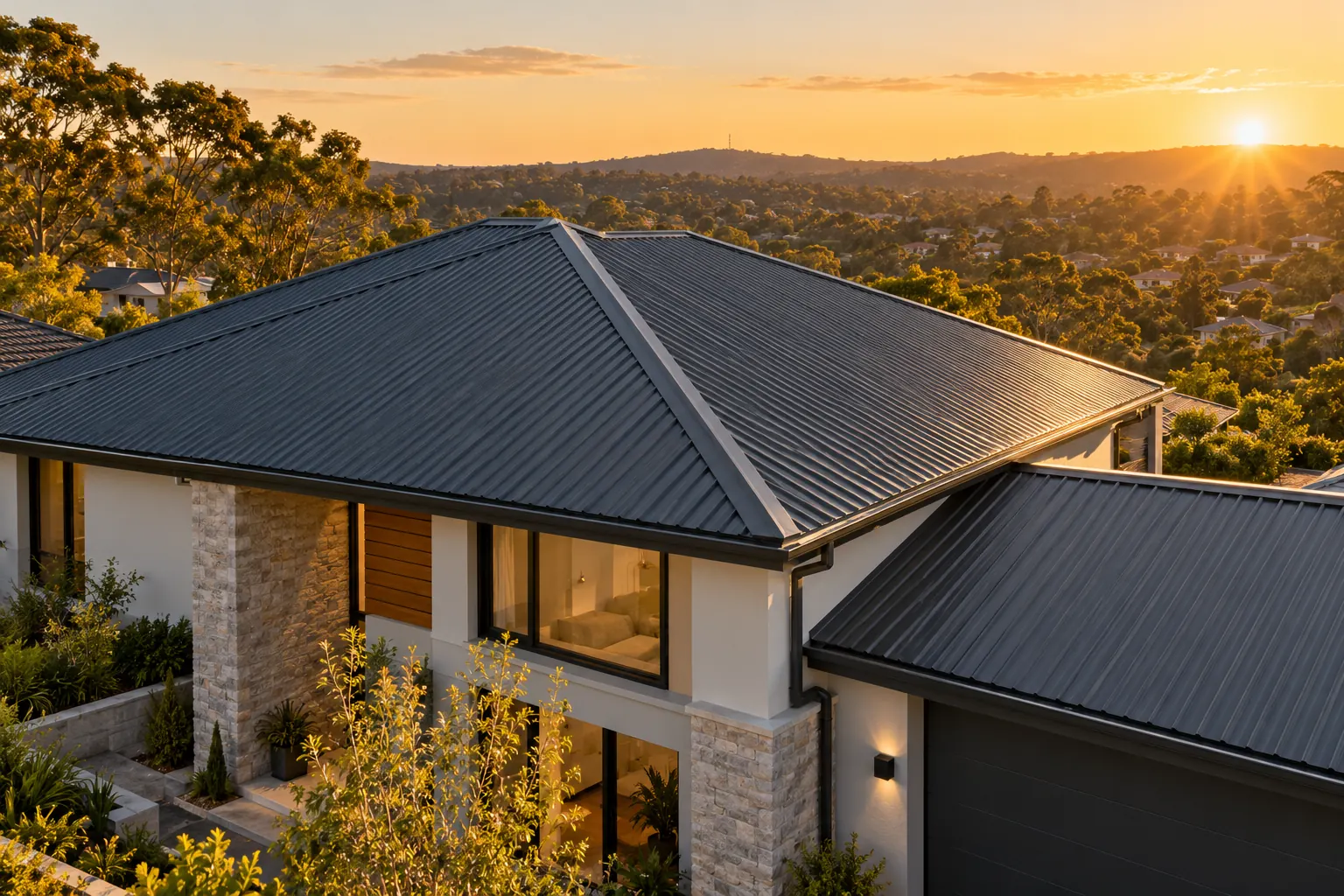
Repair suits a localised problem: a blocked outlet, a sagging section, a failed join, a damaged stop end, a downpipe crushed by a reversing car.
Replacement makes sense when the gutter is rusting at multiple joins, when the profile is undersized for the roof, when the fascia behind it has gone, or when you are already having roofing or re-roofing work done and the gutter has to come off anyway. Doing both at once is almost always cheaper than doing them a year apart.
Fascia replacement, capping over timber fascia, downpipes, rainheads and stormwater connections all sit in the same conversation.
Gutter pricing comes down to:
The inspection is free, you get photos from gutter level, and the quote is written and itemised. Call (02) 9100 0388 or ask for a free inspection.
If the water is already inside, start with roof repairs. After a storm has flattened a gutter or dropped a limb across it, see storm and emergency work. Gutter and leaf guard work across Glenhaven, West Pennant Hills, Galston and the full service area.
Repairs on Hills District roofs, where blocked valleys under established gums and corroded valley iron cause most leaks.
Learn more →Re-roofing large two-storey Hills homes and acreage properties, where access and roof complexity drive the job as much as floor area.
Learn more →Colorbond roofing across the Hills, from Castle Hill rebuilds to long shed and acreage roof runs at Kenthurst.
Learn more →Restoration for Hills District tile roofs: clearing years of leaf debris, rebedding ridges and recoating.
Learn more →Storm response across the Hills, including fallen-limb damage and wind-lifted ridge capping and sheet.
Learn more →Detailed roof inspections across the Hills District, including the two-storey and hard-access roofs other inspectors skip.
Learn more →Overflow with a clear gutter usually means the outlet or the downpipe is the restriction, or the gutter has lost its fall and is holding water in the middle of the run. Sometimes the gutter is simply undersized for the roof area feeding it, which happens where an extension added roof without adding drainage. All three are diagnosable in a few minutes on site.
An aluminium or steel mesh clipped over the gutter line and into the first tile course, sized so eucalypt leaf and bark sheds off rather than threading through. Plastic mesh goes brittle in the sun and sags into the gutter. The mesh aperture matters as much as the material: too open and the bark gets in, too fine and the mesh itself blocks and becomes a dam.
They are separate but they fail together. A valley full of gum leaf backs water sideways under the tiles, which is a roof leak rather than an overflow, and valley iron corrodes from the bottom up where that debris stays wet. Valley mesh is a different product to gutter mesh. Any proper gutter inspection here includes looking into every valley.
Directly. The gutter, the mesh, the downpipes and the first-flush device are the front end of your water supply. Mesh keeps the organic load out of the tank, which is the single biggest improvement most acreage properties can make to water quality. Materials in contact with a potable catchment need to be suitable, which rules some flashing and sealant choices out.
Often yes, with a properly set ladder and the right fall protection, depending on the ground below and the height. A sloping block, a courtyard, a pool or a two-storey wall with no safe ladder footing changes the answer. Access gets assessed at the inspection and is quoted as its own line so you can see what it costs rather than finding it buried in the total.
Tell us what you need and we'll get straight back to you. Prefer to talk? Call (02) 9100 0388 and speak to someone local.
Call (02) 9100 0388