Roof Repairs
Repairs on Hills District roofs, where blocked valleys under established gums and corroded valley iron cause most leaks.
Learn more →Water coming in now? Make-safe first, then a permanent repair. Storm roof damage, lifted tiles and fallen limbs across the Hills District. Call (02) 9100 0388.
Call (02) 9100 0388 and describe three things: which suburb you are in, where the water is appearing inside, and what you can see from the ground outside. That is enough to decide how urgent it is and what has to come on the first visit.
Then, while you wait:
These are two different jobs and conflating them is how people end up with a bad permanent repair.
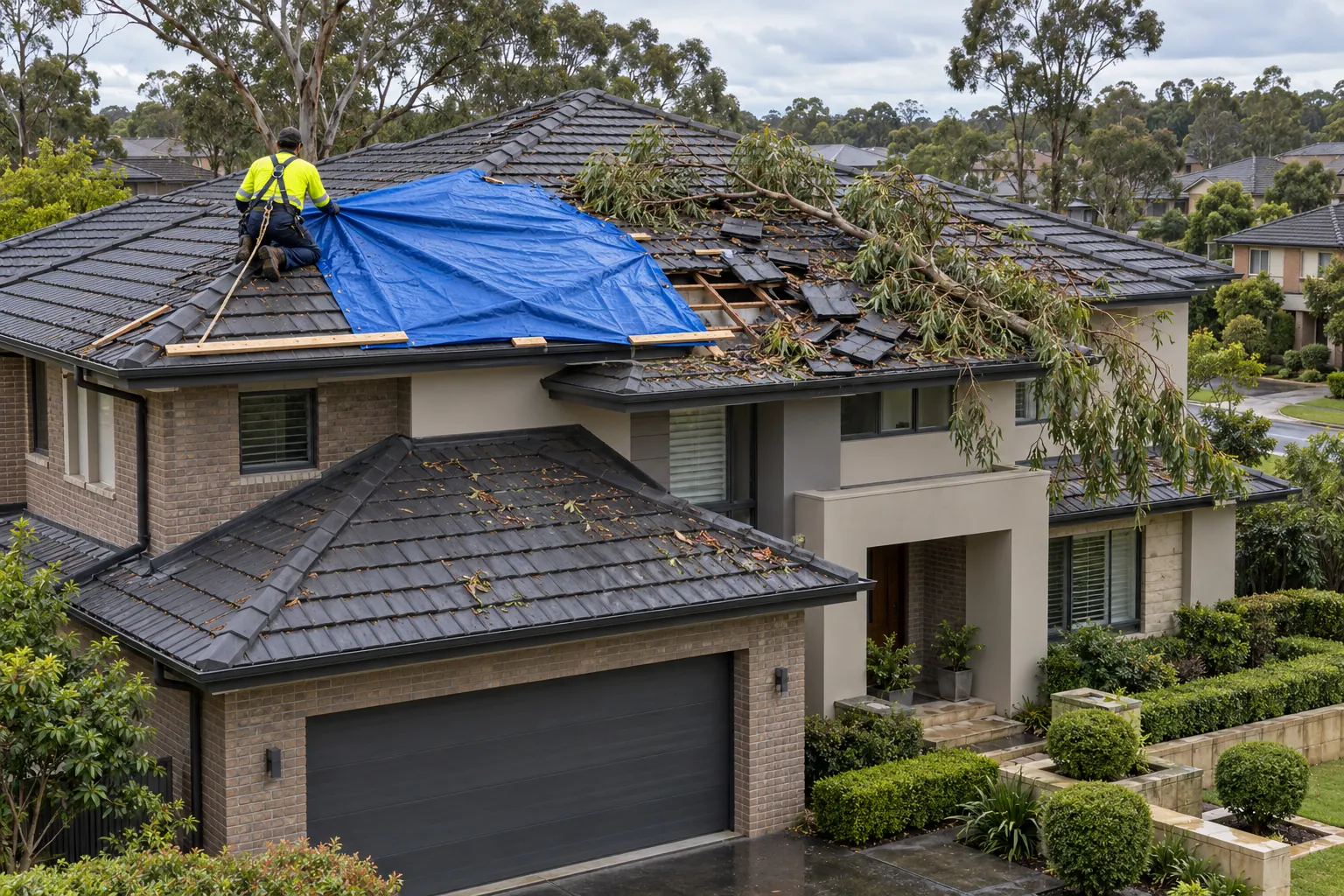
Make-safe stops the damage getting worse. Temporary cover over an opening, removing the part of a fallen limb that is bearing on the roof, clearing a valley or gutter that is forcing water inside, securing loose sheets or ridge caps so they do not become projectiles, and protecting the ceiling and contents below. It is done quickly, often in poor conditions, and it is not meant to be pretty.
The permanent repair happens once the roof is dry and can be inspected properly. That is when the real scope emerges: how many tiles actually moved, whether battens cracked, whether sarking tore, whether flashings pulled.
Rushing a permanent repair in the rain produces work that fails again in the next front.
On the exposed ridgelines and open high ground. Lifted or slipped tiles on the windward plane, ridge caps displaced where the pointing was already crazed, barge capping peeled on metal roofs, and whirlybirds or vents torn out. Wind finds whatever was already marginal.
In the heavily treed suburbs. West Pennant Hills beside Cumberland State Forest, Cherrybrook, Glenhaven and the treed parts of Castle Hill and Baulkham Hills get the falling timber version: limbs across gutters, branch strikes that crack tiles and sometimes battens, and an enormous debris load dumped into valleys and gutters in a single hour. The leak often arrives a day after the storm, when the blocked valley finally backs up.
On acreage. Dural, Kenthurst, Annangrove, Galston and Maraylya add long shed runs and large verandahs, which catch wind under the sheets, plus a much higher chance of a serious tree over something.
On the new estates. At Box Hill, Rouse Hill and North Kellyville, storm damage usually finds the detailing that was marginal to begin with: short flashing laps lifting, fixings pulling, and gutters with poor fall overflowing straight into the eaves.
Once water is through the roof it keeps travelling. The things worth checking inside, which we look at on the first proper inspection:
We are roofers, not your insurer and not a claims service. What we can do is make the documentation side straightforward:
What we will not do is tell you what your policy covers, pressure you into a claim, or inflate a scope. If the honest answer is that the damage is below your excess, you should hear that.
Emergency work is priced on what the situation actually needs. The drivers:
Make-safe and permanent repair are quoted as two separate things so you can see which is which. Nothing is invented and nothing gets added without being discussed.
Call (02) 9100 0388 for anything active. For damage that is not currently letting water in, request an inspection and we will book a proper look at it.
Once the emergency is over, the long-term fixes are usually roof repairs, gutter and leaf guard work or, where the roof was already near the end, a full replacement. Storm response across Castle Hill, Dural, Kellyville and every suburb in our service area.
Repairs on Hills District roofs, where blocked valleys under established gums and corroded valley iron cause most leaks.
Learn more →Re-roofing large two-storey Hills homes and acreage properties, where access and roof complexity drive the job as much as floor area.
Learn more →Colorbond roofing across the Hills, from Castle Hill rebuilds to long shed and acreage roof runs at Kenthurst.
Learn more →Restoration for Hills District tile roofs: clearing years of leaf debris, rebedding ridges and recoating.
Learn more →Gutter replacement and heavy-duty leaf guard for Hills properties ringed by mature gums.
Learn more →Detailed roof inspections across the Hills District, including the two-storey and hard-access roofs other inspectors skip.
Learn more →Make-safe. That means getting the water stopped and the opening covered, not completing the repair. Depending on what is involved that can be temporary cover over the breach, removing the section of limb bearing on the roof, clearing a blocked valley so water drains, and protecting what is below. The permanent repair is quoted afterwards, in daylight, with the roof dry.
No. A saturated plasterboard ceiling can hold a surprising weight of water and comes down without warning, and there may be live wiring in the cavity. Move people, pets and furniture out of the room, turn the power off to that circuit if you can do it safely, place something to catch the water, and leave it. Tell us what you are seeing when you call.
Because storm damage is rarely only what you can see. A tile on the lawn often means a dozen more have shifted, and a limb strike can crack battens under intact tiles. An honest sequence is: make the roof safe, then inspect it properly, then quote the repair in writing. Anyone pricing a storm repair sight-unseen is guessing at your expense.
Yes, and it is worth doing while the evidence is fresh. Photographs of the damage before anything is moved, a description of what failed and what it affected, and a written scope of the repair all help a claim move. We do not act for insurers and we cannot tell you what your policy covers, but the documentation side can be prepared as a written report.
Exposure matters. A roof on open high ground takes the wind more directly, so lifted and slipped tiles and displaced ridge caps show up there first. The heavily treed suburbs have the opposite risk profile: less direct wind on the roof, but far more falling timber and far more debris loading the gutters and valleys afterwards. Different damage, same storm.
Tell us what you need and we'll get straight back to you. Prefer to talk? Call (02) 9100 0388 and speak to someone local.
Call (02) 9100 0388