Roof Replacement
Re-roofing large two-storey Hills homes and acreage properties, where access and roof complexity drive the job as much as floor area.
Learn more →Leaks, slipped tiles, rusted valley iron and blocked gutters repaired across Castle Hill, Kellyville, Dural and Galston. Free inspection and written quote.
Most calls start the same way. A ring appearing on the ceiling cornice after a wet night. A tile on the lawn after a windy one. Daylight visible through the roof space when someone finally climbs into the manhole with a torch.
The useful part of a roof repair is not the patching. It is working out where the water actually enters, which on a complex two-storey Hills roof is often several metres uphill from where it appears inside. Water runs along battens, down rafters and across sarking before it finds a plasterboard joint to drip through.
So the first job is diagnosis: in the roof space from below, and on the roof from above.
The single most common fault on tile roofs through Castle Hill, Cherrybrook, Glenhaven and West Pennant Hills. Established gums shed leaf and bark into the valley, the debris packs down and holds moisture, the galvanised valley iron corrodes from the bottom up, and water starts running under the tiles instead of down the tray. Clearing it is maintenance. Replacing a perforated valley is a repair.
Flexible pointing has a service life. Once it crazes and lifts, wind-driven rain tracks straight under the ridge caps and down into the roof space. Rebedding and repointing a ridge line is one of the highest-value repairs on a 1970s or 1980s tile roof because it stops water at the top of the roof rather than halfway down.
Two-storey brick homes are full of junctions: the lower roof meeting the upper wall, a chimney, a parapet, a changed roofline from an extension. Sealant-only flashings fail within a few years. A properly stepped and chased flashing lasts decades.
Every hole in a roof is a future leak unless it is detailed properly. Skylight shafts, solar hot-water penetrations, flues, vent pipes and whirlybirds are the usual suspects on homes built from the 1990s onwards around Kellyville and Beaumont Hills.
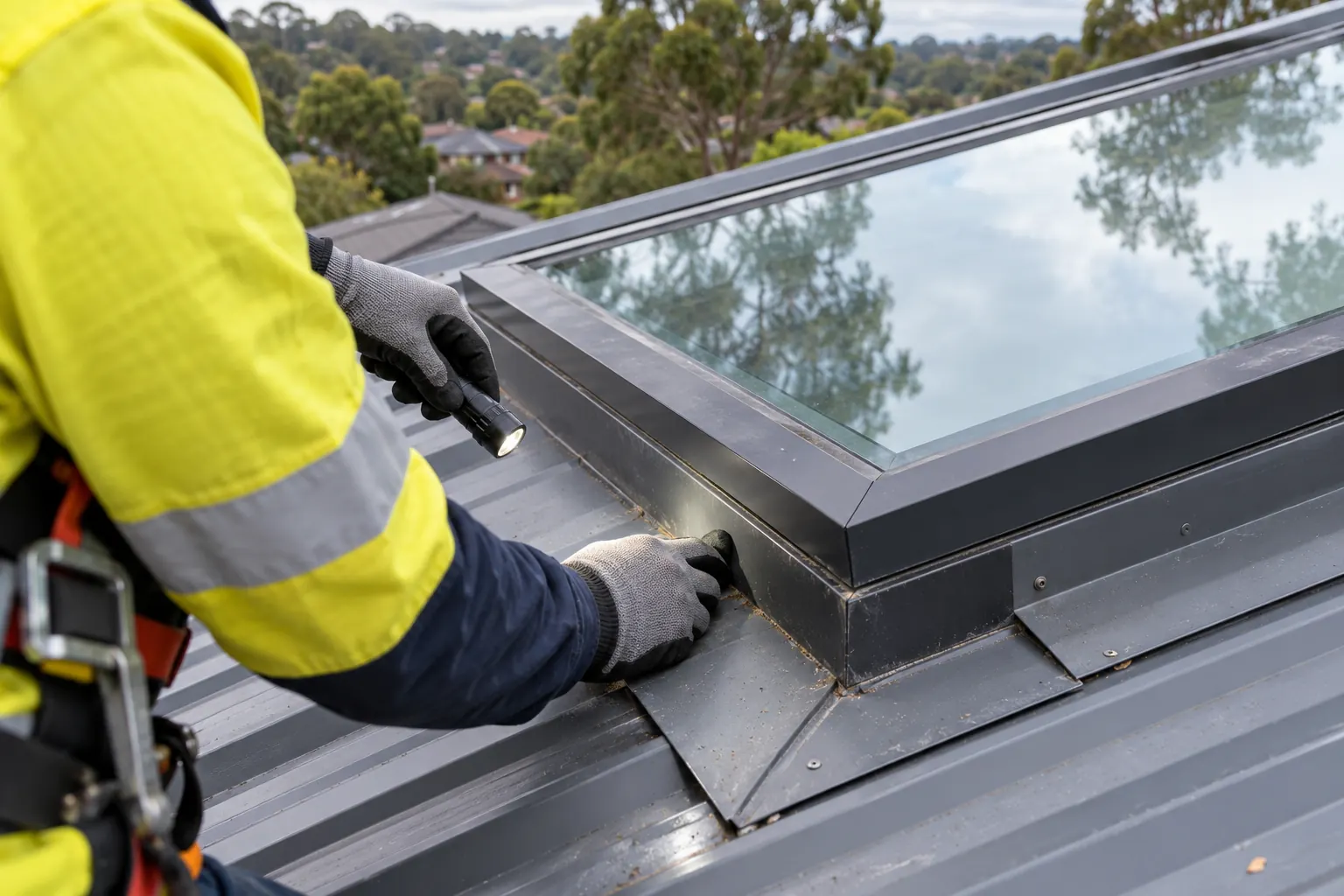
Tiles move. Trades walking the roof, a branch coming down, nail corrosion on steep pitches, or just fifty years of thermal movement. Individual tile replacement is quick; the question is always whether the sarking underneath is still doing its job.
On the newer estates at Rouse Hill, Box Hill and North Kellyville, repairs are usually about detailing rather than age: fixings driven short or over-driven, flashing laps too tight, foot traffic damage between purlins, or sealant doing a job that a flashing should be doing.
An inspection that only happens on the outside misses half the evidence. From inside the roof space we are looking for:
Condensation is worth calling out. On well-sealed newer homes with downlights, bathroom fans venting into the roof space and no ventilation, people get ceiling staining with no roof defect at all. Patching the roof would not have helped.
A broken tile is a broken tile. Reaching it is where a Hills repair differs from a repair in a single-storey suburb.
Two-storey brick homes at Castle Hill, Baulkham Hills, Cherrybrook and Glenhaven often need a longer ladder set-up on a sloping block, sometimes edge protection, and frequently a second person to work safely at height. On acreage at Kenthurst, Annangrove or Maraylya, the roof itself may be easy but the run is long and the shed is a separate set-up again.
We tell you which portion of a quote is access and which is the actual repair, so you can see what you are paying for.
Three honest outcomes, and we will tell you which one you are looking at:
There is no sensible price list for roof repairs. Two leaks that look identical on the ceiling can be twenty minutes apart or two days apart in work. What changes it:
The inspection is free and comes with photos. The quote is written and itemised. Then you decide.
Call (02) 9100 0388 and describe what you are seeing — where the stain is, what the weather was doing, what the roof is made of. Or request a free inspection and we will arrange a time.
Water through a ceiling right now is a storm and emergency job. If you need the fault documented for an insurer or a sale, start with a roof inspection and written report instead.
Repairs across Castle Hill, Baulkham Hills, Dural and the rest of the suburbs we cover.
Re-roofing large two-storey Hills homes and acreage properties, where access and roof complexity drive the job as much as floor area.
Learn more →Colorbond roofing across the Hills, from Castle Hill rebuilds to long shed and acreage roof runs at Kenthurst.
Learn more →Restoration for Hills District tile roofs: clearing years of leaf debris, rebedding ridges and recoating.
Learn more →Gutter replacement and heavy-duty leaf guard for Hills properties ringed by mature gums.
Learn more →Storm response across the Hills, including fallen-limb damage and wind-lifted ridge capping and sheet.
Learn more →Detailed roof inspections across the Hills District, including the two-storey and hard-access roofs other inspectors skip.
Learn more →A stain that stopped growing means the water stopped arriving, not that the defect closed. The next sustained easterly will reopen it, and in the meantime the plaster, the insulation batt above it and sometimes the top plate stay damp. Waiting turns a flashing or pointing repair into a ceiling replacement. Have it looked at while it is still a roof problem.
Because the entry point is above the normal waterline. Wind-driven rain pushes water uphill under tile laps, sideways through an unsealed flashing or back up a valley that is already holding debris. Vertical rain runs straight off. That is why a leak that only shows in a southerly front almost always traces back to a junction, a valley or crumbling ridge pointing rather than the open tiles.
On an older roof with torn or absent sarking, yes. Tile roofs are a water-shedding system, not a sealed membrane, and sarking is the second line of defence. Once it has perished, one hairline crack or one displaced tile delivers water straight onto the batten and down to the plasterboard. On a well-sarked roof the same tile usually causes nothing for months.
It depends on where the corrosion is. Valley iron almost always fails in the bottom metre or two where debris stays wet, and in many cases the valley can be replaced as a unit by lifting the tiles either side rather than touching the rest of the roof. If the corrosion runs the full length, or the battens underneath have gone soft, replacing the whole valley is the honest answer.
Most Hills roofs that leak need a repair, not a replacement. The inspection sorts it into three buckets: fix now, monitor and plan for later, and genuinely past economic repair. You get photographs of each so you can see the difference yourself. If a repair will buy you five more years, that is what we will say.
Tell us what you need and we'll get straight back to you. Prefer to talk? Call (02) 9100 0388 and speak to someone local.
Call (02) 9100 0388